


Indirect Transfers, Direct Impacts:
The Supreme Court of Mongolia’s Latest Ruling
on Article 30.2 of the Corporate Income Tax Law

The Supreme Court of Mongolia recently issued a landmark decision on the indirect transfer tax rule under the Corporate Income Tax Law (the “CIT Law”), ruling that the tax applies to any transfer of shares, regardless of the percentage, by an existing ultimate beneficial owner (“UBO”) of a license-holding entity.
Under the General Taxation Law, a UBO is defined as any person or entity owning, directly or indirectly, 30% or more of the shares, participation interest, or voting rights in the entity holding a mineral licenses or a land right.
Article 30.2 of the CIT Law provides that a sale or other transfer of shares, participation interest, or voting rights held by a UBO of a company holding a mineral license or land right is considered an indirect sale or transfer of that underlying mineral license or land right, resulting in an indirect transfer tax obligation for the license-holding company.
Although the provision does not, on its face, require any change in the identity or composition of the UBO to trigger the indirect transfer tax, a common reading of Article 30.2 was that it applied only where a transfer crossed the 30% threshold and thereby caused a shareholder to acquire or lose the UBO status. This interpretation had been reflected in some of the Supreme Court’s own decisions as recently as March 2026.
However, three months later, on June 15, 2026, the Supreme Court reversed course, holding that any transfer by a UBO triggers the indirect transfer tax, even where the transferor remains a UBO after the transfer.
1. What are the case facts?
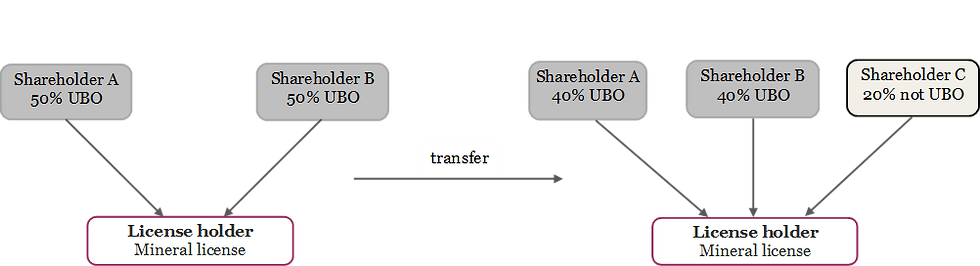
The Supreme Court set a precedent in a case involving the transfer of an aggregate of 20% shares in a mineral license-holding entity owned equally by two shareholders, (50% each), both qualifying as UBOs.
In late 2020, each shareholder transferred a 10% stake to a third party, resulting in a transfer of 20% of the company’s total shares. Each transferor remained a UBO with their remaining 40% shares and the new, third shareholder’s 20% stake fell below the 30% threshold for UBO status.
Shareholding Structure Before and After the Share
Transfer
2. How did the courts rule?
The Capital City Tax Department imposed indirect transfer tax on the license-holding company, holding that any partial transfer of shares by an UBO is taxable under Article 30.2 and the CIT Law does not require a change in the UBO status.
Both the first and appellate level courts decided in favor of the taxpayer, annulling the taxes imposed. The appellate court reasoned that Article 30.2 taxes a transfer of 30% or more of a company’s shares or participation interest that results in a change to the company’s UBO.[1] Because the acquirer’s 20% stake fell short of the 30% ownership threshold, no UBO change occurred, and therefore, the appellate court found no taxable event.
The Supreme Court reversed the lower courts’ decisions and held that the transaction was fully taxable under Article 30.2 of the CIT Law. The Supreme Court found that Article 30.2 turns solely on whether the transferor held UBO status before the transfer, not on the size of the transfer or whether the recipient itself became a UBO. Because each transferor qualified as a UBO prior to the transaction, any partial or full transfer of shares by such transferor triggers the indirect transfer tax.
3. “The change in UBO” test – where might it have come from?
Before the Supreme Court’s June 2026 ruling, a rather common interpretation of Article 30.2 had been that the CIT Law requires a transfer of at least a 30% stake resulting in a change to a company's UBO. Notably, in a separate case decided in March 2026, the Supreme Court reasoned that the income earned in connection with the change in UBO by way of a transfer of shares or participation interest is considered, under the CIT Law, the taxable income of the license-holding entity.
This interpretation may trace back to the predecessor provision of Article 30.2. Before the current, restated CIT Law, Article 8.2.2 of the 2006 Corporate Income Tax Law (“2006 Law”) provided that the income earned by a legal entity or its UBO transferring shares or participation interest to others "by way of changing" the ultimate owner of a mineral license or land right is considered the sale of rights income of the license holder. The 2006 Law expressly conditioned taxability on a resulting change in ownership. But this language was removed when the CIT Law was restated in 2019. Article 30.2, as it now reads, taxes a UBO's sale or transfer, either in full or in part, of the shares, participation interest, or voting rights they hold, with no reference to any resulting change in the company's UBO.
4. The Implication: Status over Substance?
The June 2026 decision of the Supreme Court, turning solely on the transferor's UBO status before the transfer, regardless of transfer size or resulting UBO change, appears to closely follow the actual text of the law now in force. However, it poses a fair question: has the statutory intent of taxing an indirect transfer of mineral license and land right, in full or in part, achieved through a substantial change in equity control been lost in the 2019 revision?
Under the Court’s June 2026 approach, a UBO’s transfer of even a mere 1% stake is fully taxable, purely by virtue of the transferor’s UBO status, while a 29% transfer by a shareholder who has not yet crossed the 30% threshold triggers no indirect transfer tax.
5. Practical Recommendations for Practitioners and Investors
Re-evaluate Minority Stake Dispositions: Shareholders selling minority equity (e.g., 5% or 10%) should re-evaluate the assumption that retaining UBO status precludes tax liability. If the seller is a UBO, any transfer, regardless of size, triggers indirect transfer tax under Article 30.2 of the CIT Law.
Structure Tax Indemnities in Agreements: Because statutory tax remittance liability falls on the rights-holding entity within 30 calendar days, agreements (e.g., Share Purchase Agreement) should include explicit tax withholding and indemnity clauses allocating liability between seller and license-holding entity.
Quantify Before Restructuring: Before restructuring a transaction solely to avoid Article 30.2 exposure, sellers should first obtain an assessment of the actual tax liability. For land rights, taxable income is the underlying value less acquisition cost, multiplied by the percentage of shares transferred; for mineral and petroleum licenses, the license must be valued under a cost-, market-, or income-based method, then multiplied by the transferor's UBO ownership percentage. Either figure may be more modest than assumed, particularly for smaller stakes.
Download a PDF copy of this insight in English or Mongolian.
Relevant Contacts:
 |  |
This information has been prepared by Saruul Onch LLC for general informational purposes only and does not constitute legal advice. It does not create an attorney-client relationship between the reader and Saruul Onch LLC. While accurate as of the date of preparation, this information may become outdated due to subsequent changes in law or circumstance, and we assume no obligation to update it. We accept no liability for any action taken, or not taken, in reliance on it.


Comments